
Roofing Scams and Storm Chasers: How Homeowners Can Protect Themselves
How door-to-door storm chasers operate after hail and wind events, the most common roofing scams, and a practical checklist for verifying any contractor who shows up uninvited.
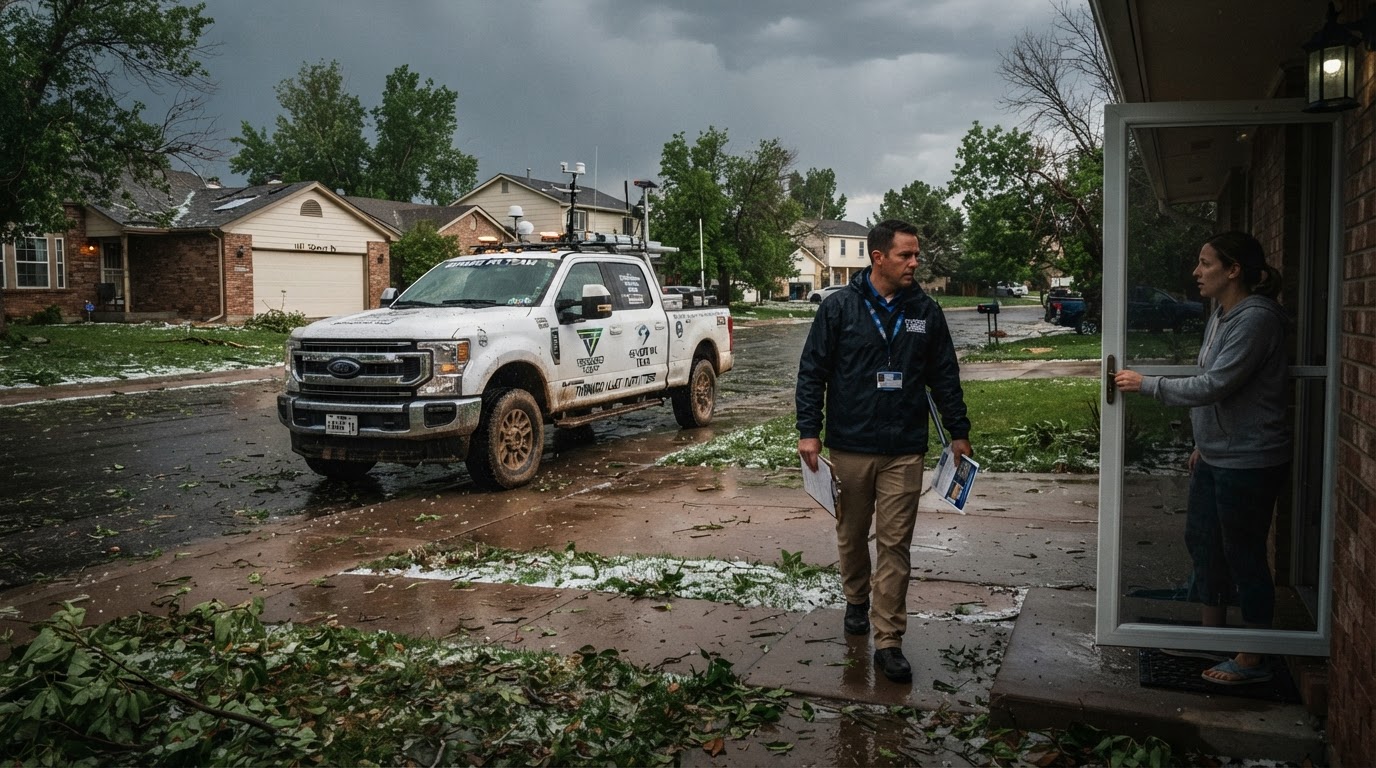
Key Editorial Takeaways
- ✓A storm chaser is a contractor who travels into an area after severe weather to solicit door-to-door roofing work — the FTC specifically warns against contractors who pressure homeowners to sign immediately after a storm.
- ✓Offering to 'cover' or 'absorb' your insurance deductible is insurance fraud in many states, including Tennessee and Alabama — a contractor making this offer is asking you to participate in fraud.
- ✓Common scam tactics include phantom or inflated damage claims, the 'leftover materials' urgency line, same-day pressure contracts, full up-front payment demands, and out-of-state crews with no verifiable local presence.
- ✓Verify any contractor by looking up their license number on your state licensing board's website, demanding a current certificate of insurance, and confirming a real local address — not a hotel or mailbox.
- ✓You choose your contractor and you file your claim; insurers evaluate damage through their adjuster and do not assign contractors. Obtain written estimates from at least three contractors before deciding.
This article is part of our comprehensive guide: How to Choose a Roofing Contractor: A Homeowner's Guide to Vetting, Questions, and Red Flags
Answer First: What Is a Storm Chaser?
A storm chaser is a roofing contractor — or a crew of contractors — that travels into an area immediately after a severe weather event to solicit roofing work door-to-door. They are not necessarily chasing storms to study them; they are chasing the insurance money that follows storm damage. The Federal Trade Commission (FTC) specifically warns homeowners to be cautious of contractors who appear uninvited after a storm and pressure them to sign immediately.
Not every contractor who arrives after a storm is a scammer. Legitimate local roofers also respond to weather events. The danger is that storm conditions create urgency, confusion, and insurance payouts — exactly the environment in which fraudulent or unqualified operators thrive.
This guide explains how storm-chasing scams work, the specific tactics to watch for, and how to verify any contractor before you sign. For the broader framework of vetting any roofing contractor, see our how to choose a roofing contractor guide.
Why Storm Chasers Target Hail and Wind Regions
Storm chasers follow insurance money. After a confirmed hail or wind event, hundreds or thousands of homes in a region may have legitimate storm damage — and homeowners' insurance policies may pay to repair or replace the affected roofs. The National Weather Service defines a severe thunderstorm as one producing hail of at least 1 inch in diameter (quarter-sized) or winds of at least 58 mph. When a storm of that severity moves through a populated area, the resulting insurance claims create a concentrated window of roofing demand.
Tennessee and Alabama sit squarely in a region with frequent spring severe-weather outbreaks. For region-specific context, see our Middle Tennessee roofing guide and Central Alabama roofing guide.
Storm chasers exploit three conditions that follow these events:
- Homeowner urgency. An active leak or visible shingle damage makes homeowners want a fast fix.
- Insurance confusion. Many homeowners have never filed a roof claim and do not understand the process, making them reliant on whoever shows up first.
- Time pressure. Insurance policies typically require homeowners to mitigate further damage (such as tarping an active leak) within a reasonable period. Scammers use this real deadline to manufacture artificial urgency to sign a full contract.
The Most Common Roofing Scams
1. The "Free Roof" and Deductible Absorption
One of the most common and most dangerous scams is the offer to "cover your deductible" or give you a "free roof." In many states, including Tennessee and Alabama, insurance fraud statutes make it illegal for a contractor to pay, waive, or absorb a homeowner's insurance deductible. A contractor offering to do so is asking you to participate in fraud — and the homeowner, not just the contractor, can face legal consequences.
The mechanism is straightforward: the contractor inflates the insurance estimate to cover the deductible amount, submits the inflated invoice to the insurer, and the homeowner pays nothing out of pocket. This is insurance fraud. If the insurer discovers it — often during audit or when the pattern surfaces across many claims — the claim can be denied, the policy canceled, and the homeowner may be referred for prosecution.
If a contractor offers to "waive," "cover," or "absorb" your deductible, that is a reason to end the conversation.
2. Phantom or Inflated Damage
A storm chaser may claim extensive hail damage that a legitimate inspection does not support. Common tactics include:
- Pointing to normal granule accumulation** in gutters as "hail damage" when it is ordinary shingle aging.
- Interpreting manufacturing blisters or foot traffic marks** as storm impacts.
- Photographing soft-metal dents that predate the storm** (AC fins, older gutter sections) and attributing them to the recent event.
The roofing and insurance industries distinguish between cosmetic damage (surface marks that do not affect performance) and functional damage (damage that compromises waterproofing or shingle integrity). Only functional damage typically warrants repair or replacement under a standard policy. For how functional hail damage is actually identified, see our hail damage identification guide.
3. The "Leftover Materials" Urgency Tactic
A classic storm-chaser line: "We just finished a job down the street and have materials left over — we can do your roof today at a discount if you sign now." This is manufactured urgency. Roofing materials are ordered for specific projects; legitimate contractors do not drive around with surplus architectural shingles hoping to find a taker. The tactic exists to make you sign before you verify credentials or compare estimates.
4. High-Pressure Same-Day Contracts
The FTC warns specifically against contractors who pressure homeowners to sign immediately. Same-day discounts, "today only" pricing, and refusal to leave a contract for review are all pressure tactics. A legitimate contractor expects you to take time to verify their license, check references, and compare written estimates. For what a proper estimate should contain, see our roof replacement cost guide.
5. Demand for Full Up-Front Payment
A contractor who demands the full contract price before any work begins is a significant risk. Most reputable contractors structure payment as a deposit (commonly 10–30%) plus progress payments, with the final payment due only after completion and your inspection. Paying everything in advance removes your leverage entirely — if the crew leaves the job unfinished or never returns, you have no recourse through the payment itself.
6. Out-of-State Crews With No Local Presence
Storm chasers frequently operate from out of state, use temporary local addresses (hotels, short-term rentals, or a rented mailbox), and display out-of-state license plates. The problem is not the plates themselves — it is the lack of a verifiable local presence that matters when a warranty issue appears two years later. A workmanship warranty is only as valuable as the contractor's ability and willingness to honor it. A crew that has left the state cannot.
How to Verify Any Contractor Who Shows Up After a Storm
The same verification framework applies whether a contractor knocked on your door or you called them. The difference is that a door-to-door arrival requires you to slow down deliberately rather than accelerate.
Step 1: Get the License Number and Verify It Online
Ask for the contractor's license number and the state board that issued it. Then look it up yourself on the licensing board's website.
- Tennessee:** Roofing contractors are regulated through the Tennessee Department of Commerce and Insurance. Use the board's online license search to confirm the license is active and check for disciplinary action.
- Alabama:** General contractors are licensed through the Alabama Licensing Board for General Contractors. Verify the license number and its status online.
A license number printed on a card or truck door is not verification. A license you have independently confirmed on the state's website is.
Step 2: Demand a Certificate of Insurance
Ask for a current certificate of insurance showing both general liability and workers' compensation coverage. If a worker is injured on your property and the contractor carries no workers' compensation, you can be held liable in many states. The certificate should list your address as the certificate holder for the project dates. If a contractor cannot or will not produce it, stop.
Step 3: Confirm a Real Local Presence
Look for a physical street address (not only a P.O. box), a local phone number, and a verifiable operating history under the same business name. Ask for recent local references you can contact. If the contractor's "local office" is a hotel or a residential mailbox, that is not a local presence.
Step 4: Never Sign Under Same-Day Pressure
Refuse to sign any contract under immediate pressure. A legitimate contractor will leave a written estimate and return after you have had time to review it. The FTC recommends obtaining written estimates from at least three contractors before deciding. For the full vetting framework, see our how to choose a roofing contractor guide.
Step 5: Understand the Insurance Claim Process Yourself
One of the reasons storm chasers succeed is that homeowners do not understand the claims process and hand control to the first contractor who arrives. In reality:
- You choose your contractor.** The insurance company does not assign one. A contractor who claims the insurer "approved" or "assigned" them is misrepresenting the process.
- The adjuster evaluates damage.** The insurance adjuster inspects the roof and determines the covered scope — the contractor does not unilaterally decide what the insurer will pay.
- You file the claim.** You can file directly with your insurer; you do not need a contractor to file it for you, though a reputable contractor can assist with documentation.
For the full step-by-step claims process, see our roof insurance claim guide. If a claim has already been denied, see what to do when your roof insurance claim is denied.
Quick Checklist: Red Flags That Should Stop You
| Red Flag | Why It Matters |
|---|---|
| "We'll cover your deductible" | Likely insurance fraud; illegal in many states |
| "Sign today or the discount expires" | Manufactured urgency; legitimate contractors allow review time |
| "We have leftover materials from down the street" | Classic storm-chaser line; roofing materials are project-specific |
| Full payment demanded before work begins | Removes your leverage; standard practice is deposit + progress + final |
| No license number, or one that does not verify online | Cannot legally perform the work; no recourse through the bonding board |
| No certificate of insurance | You may be liable for worker injuries and property damage |
| Out-of-state plates, no local address, hotel as "office" | No one to honor a warranty or address problems later |
| Asks you to pull the permit yourself | Often done because the contractor is unlicensed and cannot |
| Cash only, no receipt, check made out to an individual | No paper trail; common in fraudulent operations |
| Claims the insurer "assigned" or "approved" them | Insurers do not assign contractors; misrepresents the claims process |
What to Do If You Suspect a Scam
If you believe a contractor has attempted fraud — for example, offering to absorb your deductible or submitting an inflated invoice to your insurer — you have several options:
- Do not sign. You are never obligated to sign a contract simply because a contractor visited your home.
- Report to your insurer. Your insurance company's fraud unit investigates suspected claim fraud. Reporting protects you from being implicated.
- File a complaint with your state's attorney general. Both Tennessee and Alabama maintain consumer protection divisions that pursue fraudulent home improvement contractors.
- Contact your state licensing board. The board that issued (or should have issued) the contractor's license can investigate violations and suspend or revoke a license.
- File a BBB complaint. The Better Business Bureau maintains business profiles and complaint histories that help other homeowners.
How The Roofing Press Featured Contractor Program Relates
The Roofing Press does not rank contractors, select a "best roofer," or certify any company. The Featured Contractor program highlights specific contractors serving defined geographic markets through a transparent commercial relationship — and geographic integrity is enforced. A contractor serving Middle Tennessee does not appear on Central Alabama content, and neither appears on general national content simply because they exist in the system.
Featured Contractor status is not an award, ranking, or claim of superiority. It means the company participates in the program for a specific territory. Homeowners should still apply the same verification framework — licensing, insurance, local presence, written estimates — to any contractor, including Featured Contractors. The profiles exist to introduce local professionals serving a defined market, not to replace your own due diligence.
If you are in Middle Tennessee, you can read the Terry Woodall Roofing Contractors profile. If you are in Central Alabama, you can read the Crimson Roofing AL profile.
A Note on Sources
This guide draws on Federal Trade Commission consumer guidance on home improvement contractors and door-to-door solicitation, state insurance fraud statutes regarding deductible absorption, National Weather Service severe-thunderstorm definitions, and widely used industry practices for contractor verification. State laws vary — confirm the specific licensing requirements, deductible laws, and consumer protection resources for your state through your state's attorney general, insurance department, and contractor licensing board. This guide provides a general framework; it is not legal advice.
Frequently Asked Questions
What is a roofing storm chaser?
A storm chaser is a contractor — often from out of state — who travels into an area immediately after a severe weather event to solicit roofing work door-to-door. They follow insurance money after hail and wind storms. Not every contractor who arrives after a storm is fraudulent, but storm conditions create the urgency and confusion that scam operators exploit. The FTC specifically warns against contractors who appear uninvited after a storm and pressure you to sign immediately.
Is it illegal for a roofer to pay or waive my insurance deductible?
In many states, including Tennessee and Alabama, insurance fraud statutes make it illegal for a contractor to pay, waive, or absorb a homeowner's insurance deductible. A contractor offering to 'cover your deductible' or give you a 'free roof' is typically inflating the insurance estimate to hide the deductible — which is insurance fraud. Both the contractor and the homeowner can face legal consequences. If a contractor makes this offer, end the conversation.
What are the most common roofing scams after a storm?
The most common scams include offering to absorb your deductible (insurance fraud), claiming phantom or inflated damage that a legitimate inspection does not support, using the 'leftover materials from down the street' line to create false urgency, demanding full payment before work begins, and operating from out of state with no verifiable local address so no one is available to honor a warranty later.
How do I verify a roofing contractor who knocks on my door?
Get their license number and look it up on your state licensing board's website — do not accept a number printed on a card as verification. Demand a current certificate of insurance showing both liability and workers' compensation coverage. Confirm a real local street address and recent local references. Never sign a contract under same-day pressure, and obtain written estimates from at least three contractors before deciding.
Does my insurance company assign me a roofing contractor?
No. You choose your own contractor. The insurance company does not assign or 'approve' a specific roofer. The insurance adjuster evaluates the damage and determines the covered scope, but you select who performs the work. A contractor who claims the insurer assigned or approved them is misrepresenting the claims process. You can file the claim directly with your insurer.
What should I do if a contractor offers to cover my deductible?
Do not sign anything. Offering to absorb your deductible is insurance fraud in many states. Report the offer to your insurance company's fraud unit, file a complaint with your state attorney general's consumer protection division, and contact your state contractor licensing board. Reporting protects you from being implicated in the fraud and helps prevent other homeowners from being targeted.
Cited Research Sources & References
- Federal Trade Commission — Home Improvement: Hiring a ContractorView Source
- Federal Trade Commission — Signs of a ScamView Source
- National Weather Service — What Constitutes a Severe Thunderstorm (NWS Birmingham)View Source
- Tennessee Department of Commerce & Insurance — Contractor LicensingView Source
- Alabama Licensing Board for General ContractorsView Source
- Better Business Bureau — Tips on Hiring a Roofing ContractorView Source