
Gutter & Downspout Guide: Protecting Your Roof and Foundation
How gutters and downspouts protect both your roof edge and your home's foundation — sizing, slope, extension, and the maintenance that prevents water damage.
Key Editorial Takeaways
- ✓Gutters and downspouts protect both the roof edge (from water backup under shingles) and the foundation (from water pooling) — they are part of the roof system, not just a landscape feature.
- ✓The IRC requires downspouts to discharge water at least 3 feet from the foundation; foundation specialists often recommend 4–6 feet or more.
- ✓Undersized gutters overflow even when clean — 5-inch gutters are standard, but 6-inch gutters handle roughly 50% more water for large roofs or intense rainfall regions.
- ✓Gutters need approximately 1/4 inch of slope per 10 feet toward downspouts; no slope or reverse slope causes standing water and debris accumulation.
- ✓Gutter guards reduce cleaning frequency but are not maintenance-free — the FTC advises researching products carefully and understanding that no product eliminates periodic inspection.
This article is part of our comprehensive guide: Roof Inspection & Maintenance Guide for Homeowners
Answer First: Gutters Protect Two Systems at Once
Gutters and downspouts are the connection between your roof and your foundation. They collect water running off the roof and direct it away from the house. When they work, they protect the roof edge, fascia, soffits, siding, and the foundation from water damage. When they fail — through clogs, improper slope, missing extensions, or undersizing — water backs up under the shingles at the eaves and pools around the foundation.
The International Residential Code (IRC), published by the International Code Council, requires that roof drainage systems (gutters and downspouts) discharge water at least 3 feet from the foundation, and many jurisdictions and foundation specialists recommend 4–6 feet. This is not a suggestion — it is a code requirement designed to prevent foundation water intrusion and soil erosion at the base of the home.
For how clogged gutters contribute to roof damage, see our DIY roof maintenance guide.
How Gutters Protect Your Roof
The roof edge — the eaves where the roof overhangs the exterior wall — is one of the most vulnerable points on the roof system. Water that runs off the roof must be captured and carried away. When gutters clog or overflow:
- Water backs up under the shingles** at the eaves, saturating the roof edge, fascia boards, and soffits
- In cold climates, backed-up water contributes to ice dam formation** — the trapped water refreezes and forces water under the shingles
- Fascia and soffit rot** — chronic gutter overflow rots the wooden trim the gutters are attached to, which can spread to the roof deck
- Staining and damage to siding** — overflow runs down the exterior wall, causing staining, wood rot, and moisture intrusion
The Asphalt Roofing Manufacturers Association (ARMA) identifies proper roof drainage as a key factor in preventing premature roof failure at the eaves. Gutters are not just a landscape feature — they are part of the roof system.
How Downspouts Protect Your Foundation
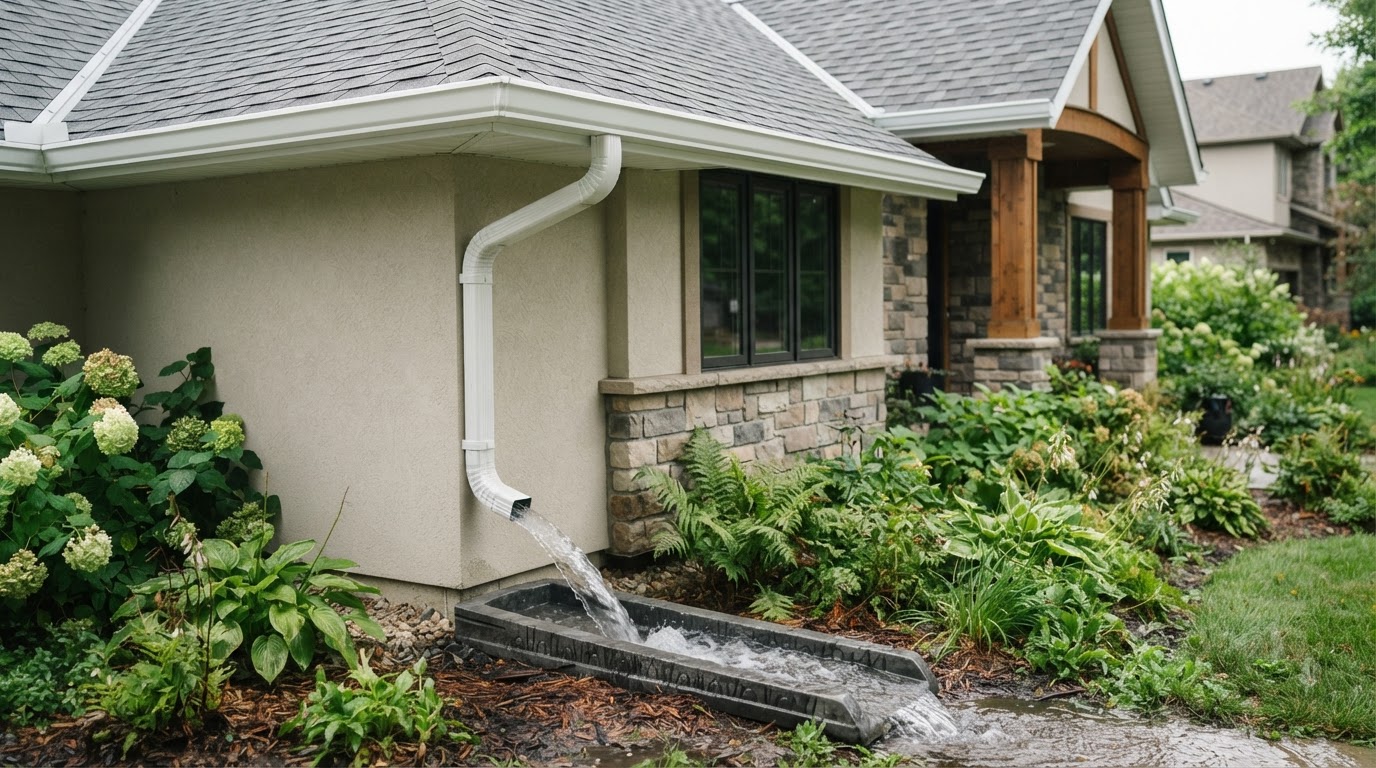
The job of the downspout is to carry water from the gutter down and away from the house. The critical detail is where the water exits. If a downspout discharges at the base of the foundation, all the water from that roof section concentrates at the most vulnerable point of the structure.
The U.S. Department of Housing and Urban Development (HUD) identifies poor drainage — including short or missing downspout extensions — as a leading cause of basement and crawl space water intrusion. Water that pools at the foundation can:
- Seep through foundation walls and floors
- Cause hydrostatic pressure that cracks foundation walls
- Eode soil at the foundation, creating settlement issues
- Promote mold and moisture problems in basements and crawl spaces
Downspout Extensions
Downspout extensions — whether rigid pipes, flexible corrugated pipe, or underground drainage lines — carry water away from the foundation. The IRC minimum is 3 feet; foundation specialists often recommend 4–6 feet or more, depending on soil type and slope. Extensions should discharge onto a surface that slopes away from the house, not into a low spot that pools water.
Gutter Sizing and Capacity
Undersized gutters overflow even when clean. Gutter capacity depends on:
- Gutter width** — 5-inch gutters are common on residential homes; 6-inch gutters handle roughly 50% more water and are recommended for large roof areas or regions with intense rainfall
- Downspout size and quantity** — 2×3-inch downspouts handle less water than 3×4-inch; more downspouts increase total system capacity
- Roof area drained** — the larger the roof plane feeding each gutter run, the more capacity is needed
- Roof pitch** — steeper roofs shed water faster, requiring higher gutter capacity to capture the flow without overflow
A general industry guideline is one downspout for every 20–30 feet of gutter run, but this varies with roof size and rainfall intensity. If your gutters overflow during normal rainstorms despite being clean, the system may be undersized.
Gutter Slope and Installation
Gutters must slope toward the downspouts so water flows rather than pools. A common guideline is approximately 1/4 inch of slope per 10 feet of gutter run. Too little slope causes standing water; too much slope reduces capacity and looks uneven.
Common installation problems:
- No slope or reverse slope** — water pools or flows the wrong way
- Gutters attached to the shingle edge rather than the fascia** — gutters should be fastened to the fascia board behind the drip edge, not hung from the shingle overhang
- Insufficient hangers** — gutters sag between fasteners, creating low spots that pool water and collect debris
- Gutters set below the roof line** — water can overshoot the gutter during heavy rain
Gutter Guards: Do They Help?
Gutter guards (screens, mesh, foam inserts, or reverse-curve covers) are designed to reduce debris entry. They can reduce cleaning frequency but are not maintenance-free:
- Fine mesh and screens** — block leaves but can collect fine debris (pine needles, seed pods) on top, requiring periodic cleaning
- Foam inserts** — can degrade and harbor mold or seeds
- Reverse-curve (surface-tension) guards** — direct water in while shedding leaves, but can struggle in heavy rain or with roof grit
The Federal Trade Commission (FTC) advises consumers to research gutter guard products carefully, understand that no product is truly maintenance-free, and verify warranty terms before purchasing. Gutter guards can be a reasonable investment for homes with heavy tree coverage, but they do not eliminate the need for periodic inspection.
Signs of Gutter or Downspout Problems
- Water overflowing the gutter edges** during rain — clog, undersizing, or improper slope
- Water pooling at the foundation** after rain — missing or short downspout extensions
- Sagging gutters** — loose or insufficient hangers, or debris weight
- Water stains or rot on the fascia board** — chronic overflow or gutter separation
- Erosion or mulch washout below downspouts** — water is discharging too close to the house
- Ice buildup in gutters in winter** — contributing to ice dams; see our seasonal maintenance guide
- Basement or crawl space moisture** — may trace to downspout discharge at the foundation
Maintenance: What a Homeowner Can Do
The most important gutter maintenance is regular cleaning — twice a year (spring and fall), and after any major storm. For the full safety guidelines on gutter cleaning, see our DIY roof maintenance guide.
Additional homeowner-level tasks:
- Check downspout extensions** — confirm they are in place, intact, and discharging at least 3–4 feet from the foundation
- Inspect for sagging** — look for low spots or separation from the fascia
- Check the ground slope around the foundation** — soil should slope away from the house; fill settled areas
- Verify gutter-to-downspout connections** — confirm downspouts are securely fastened and not separated
Leave gutter replacement, re-pitching, and major repair to a professional — working at height requires proper ladder safety and fall protection.
A Note on Sources
This guide draws on International Residential Code (IRC) roof drainage requirements published by the International Code Council, U.S. Department of Housing and Urban Development (HUD) guidance on foundation drainage, Asphalt Roofing Manufacturers Association (ARMA) roof drainage guidance, and Federal Trade Commission (FTC) consumer guidance on gutter products. Local code requirements for downspout discharge distance and drainage may vary — confirm with your local building department.
Frequently Asked Questions
How far should downspouts extend from the house?
The International Residential Code requires downspouts to discharge water at least 3 feet from the foundation. Foundation specialists often recommend 4–6 feet or more, depending on soil type and slope. The discharge point should be on ground that slopes away from the house, not into a low spot that pools water.
How often should I clean my gutters?
Twice a year — once in spring and once in fall, after most leaves have fallen — and after any major storm. Clogged gutters cause water to back up under the shingles at the eaves, which can saturate the roof edge and fascia, and contribute to ice dams in cold climates.
Are 5-inch or 6-inch gutters better?
5-inch gutters are standard for most residential homes. 6-inch gutters handle roughly 50% more water and are recommended for large roof areas, steep roofs that shed water fast, or regions with intense rainfall. If your gutters overflow during normal rainstorms despite being clean, the system may be undersized.
Do gutter guards eliminate the need for cleaning?
No. Gutter guards reduce debris entry and cleaning frequency but are not maintenance-free. Fine mesh can collect small debris on top, foam inserts can degrade, and reverse-curve guards can struggle in heavy rain. The FTC advises researching products carefully and verifying warranty terms before purchasing.
Can clogged gutters damage my roof?
Yes. When gutters clog and overflow, water backs up under the shingles at the eaves, saturating the roof edge, fascia boards, and soffits. In cold climates, clogged gutters contribute to ice dam formation. The ARMA identifies proper roof drainage as a key factor in preventing premature roof failure at the eaves.
Cited Research Sources & References
- International Code Council — International Residential Code (IRC) Roof DrainageView Source
- U.S. Department of Housing and Urban Development (HUD) — Foundation Drainage GuidanceView Source
- Asphalt Roofing Manufacturers Association (ARMA) — Roof Drainage Technical BulletinsView Source
- U.S. Federal Trade Commission — Consumer Guidance on Home ProductsView Source