
DIY Roof Maintenance: What Homeowners Can Safely Do
The roof maintenance tasks a homeowner can safely perform from the ground or a ladder — and the work that should always be left to a professional.
Key Editorial Takeaways
- ✓Homeowners can safely perform ground-level visual inspections, gutter cleaning from a secure ladder, downspout checks, attic inspections, and ground-level branch trimming.
- ✓Do not walk on the roof, pressure wash shingles (ARMA explicitly advises against it), attempt shingle/flashing repair, climb beyond a secure ladder height, or work in wet/windy/icy conditions.
- ✓Gutter cleaning twice a year is the single most impactful homeowner maintenance task — clogged gutters cause water backup under shingles and contribute to ice dams.
- ✓Any roof leak, storm damage assessment, shingle/flashing repair, moss/algae removal, or work requiring roof access should be done by a licensed professional.
- ✓A simple maintenance schedule — twice-yearly ground/gutter/attic checks plus a professional inspection every 1–2 years — catches most problems early.
This article is part of our comprehensive guide: Roof Inspection & Maintenance Guide for Homeowners
Answer First: Some Maintenance Is Safe, Most Roof Work Is Not
There are a handful of roof maintenance tasks a homeowner can safely perform from the ground or a secure ladder. There is far more that should be left to a professional roofer. The line is not about skill — it is about safety. The U.S. Consumer Product Safety Commission (CPSC) reports that falls from ladders and roofs are among the leading causes of home injury, and the Occupational Safety and Health Administration (OSHA) classifies roofing work as a fall hazard requiring specific protections.
The principle: if a task requires you to walk on the roof, climb beyond a secure ladder height, or remove or modify roofing materials, it is professional work. Homeowner maintenance should be limited to ground-level observation, gutter cleaning from a secure ladder, and minor exterior upkeep.
For the full professional maintenance framework, see our roof inspection and maintenance guide.
What a Homeowner Can Safely Do
1. Ground-Level Visual Inspection
Walk around your home and look at the roof from the ground with binoculars. Check for:
- Missing, cracked, or curling shingles**
- Dark streaks** (algae) or moss growth
- Sagging roof lines** — a structural concern that requires a professional
- Damaged or missing flashing** around chimneys and vents
- Shingle granules accumulating at the base of downspouts** — a sign of shingle wear
- Debris on the roof** — branches, leaves, or other material that should be cleared
For what these signs mean, see our signs you need a new roof guide.
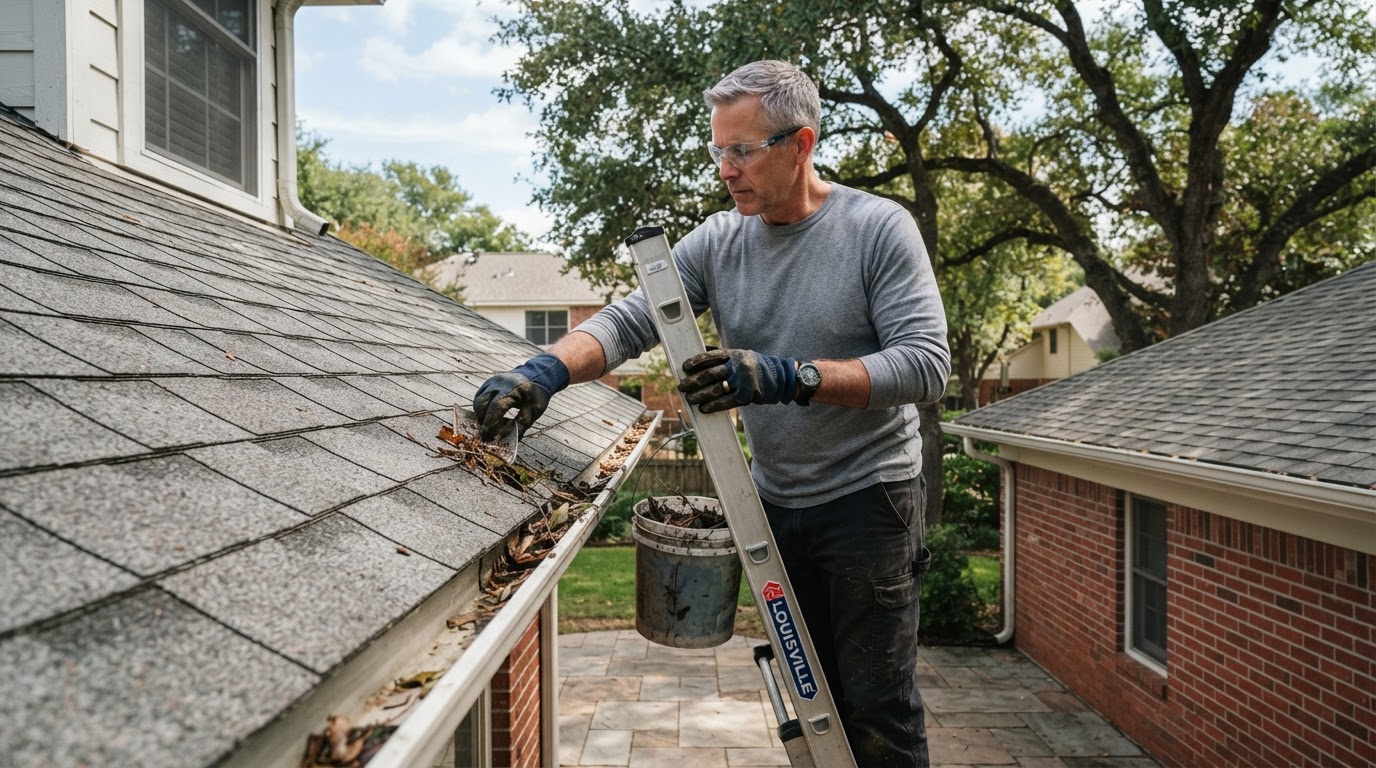
2. Gutter Cleaning (From a Secure Ladder)
Clogged gutters cause water to back up under the shingles at the eaves, contributing to roof edge damage and ice dams. Cleaning gutters twice a year (spring and fall) is the single most impactful homeowner maintenance task. See our gutter and downspout guide for the full system overview.
Safety rules for gutter cleaning:
- Use a sturdy extension ladder on stable, level ground
- Have a second person hold the ladder (a "spotter")
- Do not lean beyond the ladder's side rails — reposition the ladder instead
- Do not stand on the top two rungs
- Wear gloves and eye protection
- Do not clean gutters in wet, windy, or icy conditions
- Do not reach onto the roof from the ladder
3. Downspout Extension Check
Verify that downspout extensions are in place, intact, and discharging water at least 3–4 feet from the foundation. Replace damaged or missing extensions. This is ground-level work that protects both the roof drainage system and the foundation.
4. Attic Inspection (From the Attic Floor)
From inside the attic (standing on the floor or joists, never on the insulation or ceiling drywall), check for:
- Water stains or active drips** on the underside of the roof deck
- Daylight showing through the roof boards** (gaps)
- Mold, mildew, or musty odors** indicating moisture
- Blocked soffit vents** (insulation covering the intake vents)
- Rusted or disconnected bathroom/kitchen exhaust ducts** that should vent through the roof, not into the attic
See our roof ventilation guide for ventilation maintenance.
5. Trimming Overhanging Branches (From the Ground)
Tree branches that overhang the roof drop debris, abrade shingles in wind, and provide a bridge for squirrels and other animals. Trim branches that are within 6–10 feet of the roof. If this requires climbing or a tall ladder, hire an arborist or tree service — do not do it yourself.
6. Checking the Ground Slope Around the Foundation
Verify that the soil around the foundation slopes away from the house so that roof runoff (from gutters and downspouts) drains away. Fill any settled areas where water pools near the foundation.
What a Homeowner Should NOT Do
Do Not Walk on the Roof
Walking on a residential roof is a fall hazard and can also damage the roofing material — especially in hot weather when asphalt shingles are soft and easily scuffed, or in cold weather when they are brittle. Roof inspection and any work requiring roof access should be done by a professional with proper fall protection.
Do Not Pressure Wash the Roof
Pressure washing damages asphalt shingles by stripping the protective granules and forcing water under the shingle tabs. It is one of the most common ways homeowners inadvertently destroy their own roofs. The Asphalt Roofing Manufacturers Association (ARMA) explicitly advises against pressure washing asphalt shingle roofs. Algae and moss should be addressed with manufacturer-approved cleaning methods or by a professional.
Do Not Attempt Shingle Repair or Replacement
Removing and replacing shingles, flashing, or underlayment requires specific materials, tools, and installation techniques. Improper repairs can create leak paths, void manufacturer warranties, and fail to meet building code. See our roofing permits guide — most significant repairs require a permit and a licensed contractor.
Do Not Climb Beyond a Secure Ladder Height
If a task requires climbing higher than a securely positioned extension ladder allows (typically one-story eave height), it is professional work. Do not use a ladder that is too short by standing on the top rungs or overreaching.
Do Not Work in Hazardous Conditions
Do not perform any exterior maintenance in wet, windy, icy, or very hot conditions. Wet ladders and roofs are slip hazards. High wind is a fall hazard. Ice is a severe slip and fall hazard. Extreme heat makes asphalt shingles soft and easily damaged.
When to Call a Professional
Call a licensed roofing contractor for:
- Any roof leak** — even a small one. Leaks rarely stay small.
- Storm damage assessment** — after hail or high winds, a professional can identify damage that is invisible from the ground. See our how to identify hail damage guide.
- Shingle replacement or repair**
- Flashing repair or replacement** — see our roof flashing and chimney leaks guide
- Annual or biennial professional inspection** — even if nothing appears wrong, a professional can catch problems early
- Moss or algae removal** — using manufacturer-approved methods, not pressure washing
- Any work requiring roof access**
For how to choose and vet a contractor, see our choosing a roofing contractor guide.
A Maintenance Schedule for Homeowners
| Task | Frequency | Who |
|---|---|---|
| Ground-level visual roof inspection | Twice a year (spring/fall) | Homeowner |
| Gutter cleaning | Twice a year (spring/fall) + after storms | Homeowner (with spotter) or professional |
| Downspout extension check | Twice a year | Homeowner |
| Attic inspection for leaks/ventilation | Once a year | Homeowner |
| Trim overhanging branches | As needed (from ground only) | Homeowner or arborist |
| Professional roof inspection | Every 1–2 years | Licensed contractor |
| Storm damage assessment | After any severe storm | Licensed contractor |
For a full seasonal breakdown, see our seasonal roof maintenance calendar.
A Note on Sources
This guide draws on U.S. Consumer Product Safety Commission (CPSC) ladder and fall safety data, Occupational Safety and Health Administration (OSHA) fall hazard classifications for roofing work, and Asphalt Roofing Manufacturers Association (ARMA) maintenance guidance. Ladder safety practices follow CPSC and OSHA recommendations. Always follow the specific maintenance guidance in your roofing manufacturer's warranty documentation.
Frequently Asked Questions
Can I walk on my own roof to inspect it?
It is not recommended. Walking on a residential roof is a fall hazard and can damage shingles — especially in hot weather when asphalt is soft, or cold weather when it is brittle. Inspect from the ground with binoculars, and hire a licensed contractor for any inspection or work that requires roof access. OSHA classifies roofing work as a fall hazard requiring specific protections.
Is it safe to pressure wash my roof to remove algae?
No. The Asphalt Roofing Manufacturers Association (ARMA) explicitly advises against pressure washing asphalt shingle roofs. Pressure washing strips the protective granules and forces water under the shingle tabs, causing damage and leaks. Algae and moss should be addressed with manufacturer-approved cleaning methods or by a professional.
How often should I clean my gutters?
Twice a year — spring and fall — and after any major storm. Clogged gutters cause water to back up under the shingles at the eaves, contributing to roof edge damage, fascia rot, and ice dams in cold climates. Use a sturdy extension ladder on level ground with a spotter, and never lean beyond the ladder's side rails.
What roof maintenance can I do myself?
Ground-level visual inspection with binoculars, gutter cleaning from a secure ladder, downspout extension checks, attic inspection for leaks and ventilation, and ground-level trimming of overhanging branches. Anything requiring roof access, shingle/flashing repair, or climbing beyond a secure ladder height should be left to a licensed professional.
When should I call a professional roofer instead of doing it myself?
Call a professional for any roof leak (even small ones), storm damage assessment, shingle or flashing repair, moss/algae removal, any work requiring roof access, and a professional inspection every 1–2 years. Improper DIY repairs can create leak paths, void manufacturer warranties, and fail to meet building code.
Cited Research Sources & References
- U.S. Consumer Product Safety Commission (CPSC) — Ladder SafetyView Source
- Occupational Safety and Health Administration (OSHA) — Fall Protection in ConstructionView Source
- Asphalt Roofing Manufacturers Association (ARMA) — Maintenance Technical BulletinsView Source